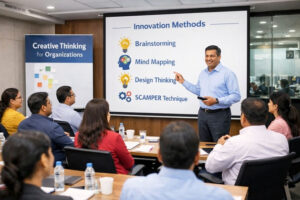
 Creative Thinking for Organizations Training from Inzinc Academy is a must-have training session to understand how to enhance creativity which is an important differentiator in today’s Corporate landscape. In today’s business environment, organizations cannot depend only on routine thinking, fixed habits, or past success. Markets change, customer needs evolve, technology shifts rapidly, and competition keeps rising. Therefore, organizations need people who can look beyond conventional answers, reframe problems, generate useful ideas, and convert possibilities into action. Creative thinking is no longer optional. Instead, it has become a core capability for solving problems, improving processes, designing better products and services, and finding new paths to growth.
At Inzinc Academy (The Training Division of Inzinc Consulting India Pvt. Ltd.), our Creative Thinking for Organizations Training helps employees, managers, leaders, and teams strengthen their ability to think differently, collaborate effectively, and innovate with purpose. Moreover, this training does not treat creativity as an abstract talent reserved for a few people. Rather, it presents creative thinking as a practical workplace skill that can be learned, encouraged, and applied. Consequently, participants gain tools, methods, and insights that support stronger problem-solving, better teamwork, and more valuable business outcomes.
Introduction to Creative Thinking for Organizations
The presentation explains creative thinking in the organizational context as the ability of individuals or teams to generate innovative and original ideas, solutions, and approaches to various challenges and opportunities. It also emphasizes that creative thinking involves going beyond conventional boundaries, exploring new perspectives, and fostering a culture that encourages and nurtures innovative thought processes. Therefore, creative thinking is not only about imagination. It is also about useful innovation inside real business conditions.
The training also compares logical thinking and creative thinking. Logical thinking uses reason, structure, and evidence to make decisions. Creative thinking, by contrast, focuses on generating new ideas, fresh possibilities, and unconventional solutions. However, the presentation makes an important point: the most effective problem-solvers use both approaches as needed. In other words, organizations do not need creativity instead of logic. Rather, they need creativity along with logic.
Who Must Take This Training?
Managers and Team Leaders
Managers must guide teams through uncertainty, process improvement, problem-solving, and change. Therefore, they benefit greatly from structured creative thinking tools and innovation-friendly leadership practices.
Product, Process, and Operations Teams
These teams often handle recurring problems, customer requirements, cost pressures, delays, and process inefficiencies. Consequently, creative thinking helps them find better methods, smarter alternatives, and more useful improvements.
Sales, Marketing, and Customer Experience Teams
Creative thinking supports new campaign ideas, better customer engagement, improved positioning, and stronger value communication. Moreover, it helps teams reframe customer problems and discover fresh opportunities.
HR, Strategy, and Business Excellence Teams
These functions often work on organization development, engagement, policy improvement, and change initiatives. Therefore, creativity helps them design stronger interventions and more practical solutions.
Organizations Seeking Innovation Culture
Any organization that wants better innovation, stronger collaboration, improved agility, and more confident problem-solving will benefit from this training.
Learning Objectives
By the end of this training, participants will be able to:
- Understand creative thinking in the context of organizational performance
- Differentiate between logical thinking and creative thinking
- Use the diverge and converge model more effectively
- Apply divergent thinking skills such as brainstorming, reframing, and questioning assumptions
- Use the SCAMPER method to generate fresh ideas
- Recognize why creative thinking matters for growth, competitiveness, and innovation
- Understand the role of leadership in fostering creative cultures
- Identify barriers to creative thinking and learn how to overcome them
- Promote collaboration, diversity, and experimentation in idea generation
- Understand how constraints can drive innovation rather than block it
- Use design thinking principles in problem-solving
- Recognize the value of empathy, storytelling, and failure in innovation
- Understand the creative process from ideation to implementation
Why Creative Thinking Matters in Organizations
The presentation states clearly that creative thinking is essential for organizations to stay competitive in a fast-paced and constantly evolving business landscape. It allows companies to develop innovative solutions to complex problems, adapt to changing market conditions, and differentiate themselves from competitors. Therefore, creative thinking directly supports business resilience and strategic advantage.
It also notes that organizations that prioritize creative thinking are more likely to outperform peers in revenue growth and market share. Additionally, the material uses examples such as Apple’s design and innovation focus to show how creative thinking can contribute to long-term business value. Thus, creative thinking is not merely inspirational language. Instead, it is closely linked to real business performance.
Training Topics Covered
Overview of Topics
- Meaning of creative thinking in an organization
- Logical thinking versus creative thinking
- The diverge and converge model
- Skills for divergent thinking
- Brainstorming, reframing, and questioning assumptions
- SCAMPER exercise and idea generation
- Examples of creative business ideas
- Why creative thinking matters
- Role of leadership in promoting innovation
- Barriers to creative thinking
- Collaboration and creative thinking
- Power of constraints
- Innovation and creative thinking
- Design thinking and user-centered problem-solving
- Importance of diversity in idea generation
- Role of failure in innovation
- The creative process from ideation to implementation
- Importance of experimentation
- Power of storytelling
- Importance of empathy in innovation and workplace culture
- Logical Thinking vs Creative Thinking
The training explains that logical thinking is most useful when there is a clear goal and a limited set of options, such as solving a math problem or making a decision based on data. Creative thinking, on the other hand, is more useful when there are many possible solutions and no single obvious answer, such as developing a new product idea or solving a complex business issue. Therefore, participants learn not only what creative thinking is, but also when it is most valuable.
This distinction is important because many organizations unintentionally overuse logic in situations that also require imagination, reframing, and experimentation. As a result, teams may become efficient at analysis yet weak in innovation. This training helps correct that imbalance.
The Diverge and Converge Model
A central concept in the presentation is the Diverge/Converge Model. It explains that creativity involves two phases. First, during divergent thinking, individuals generate as many ideas as possible without worrying about quality or feasibility. Then, during convergent thinking, the best ideas are selected, refined, and shaped into actionable plans. Therefore, the model helps participants understand that idea generation and idea selection must both be managed deliberately.
This is especially useful in organizations because teams often jump to evaluation too early. Consequently, promising ideas may be killed before they are explored properly.
Skills for Divergent Thinking
The training identifies brainstorming, reframing, and questioning assumptions as key skills for divergent thinking. Brainstorming supports rapid idea generation. Reframing helps people look at a problem from different perspectives. Questioning assumptions challenges the status quo and opens new possibilities. Moreover, the presentation explains that these skills can be applied in marketing, product development, customer service, and growth strategy.
For example, brainstorming can support new campaign ideas. Reframing can reveal new customer needs. Likewise, questioning assumptions can expose hidden limitations in current practices. Therefore, participants gain practical tools, not just conceptual understanding.
SCAMPER as a Practical Creativity Tool
The SCAMPER method is one of the most actionable tools in the training. The presentation explains that SCAMPER stands for Substitute, Combine, Adapt, Modify, Put to another use, Eliminate, and Reverse. It is used by taking an existing product, service, or process and asking structured questions to discover improvements or new uses. As a result, teams can generate a wide range of ideas that might otherwise remain hidden.
This method is especially valuable because it gives participants a repeatable way to produce ideas under real workplace constraints.
Leadership and the Creative Culture
The presentation emphasizes that leadership plays a critical role in fostering creative thinking. A leader who encourages innovation, supports experimentation, and allows thoughtful risk-taking can inspire teams to think beyond routine solutions. It uses examples such as Steve Jobs and Satya Nadella to illustrate how leadership can shape innovation culture. Moreover, it highlights collaboration and empathy as leadership qualities that support creative outcomes.
Therefore, this training is highly relevant for leadership development. Leaders do not create innovation by instruction alone. Instead, they create it through environment, language, support, and example.
Common Barriers to Creative Thinking
The presentation identifies fear of failure and groupthink as major barriers. Fear of failure discourages risk-taking and makes employees avoid experimentation. Groupthink suppresses originality when teams become too conformist or too similar in perspective. However, the training also shows how to address these barriers by promoting experimentation, rewarding thoughtful risk-taking, encouraging diversity of thought, and building open communication and debate.
This is important because many organizations ask for innovation while maintaining conditions that discourage it. Therefore, participants learn how culture either enables or blocks creativity.
Collaboration, Diversity, and Constraints
The material explains that collaboration is key to creative thinking because breakthroughs often happen when individuals combine different experiences, strengths, and perspectives. It also emphasizes the importance of diversity, noting that diverse teams are often more innovative and better at solving complex problems. Furthermore, it introduces the power of constraints, explaining that limitations can actually act as catalysts for innovation by forcing new solutions.
Consequently, the training helps participants see that creativity does not always require unlimited freedom. In many cases, the right team mix and the right constraints produce better ideas.
Innovation, Design Thinking, and the Creative Process
The presentation connects creative thinking closely with innovation. It explains that innovation happens when organizations challenge the status quo and develop new ideas that solve problems in better ways. It also introduces design thinking as a user-centered problem-solving approach involving empathy, problem definition, ideation, prototyping, testing, and iteration. Therefore, participants understand how creativity becomes structured innovation.
The training also describes the creative process as including ideation, evaluation and refinement, prototyping, and implementation. Additionally, it highlights the importance of involving users, gathering feedback, and having strong communication during launch. As a result, the training moves from idea generation all the way to practical execution.
Experimentation, Failure, Storytelling, and Empathy
Another strong feature of this training is its broader view of creative culture. The presentation explains that experimentation allows trial and error, which in turn creates room for breakthrough ideas. It also reframes failure as a natural and useful part of the innovation process, especially when organizations treat it as learning rather than punishment. Likewise, it explains how storytelling can inspire innovation and how empathy helps organizations understand customers and team members more deeply.
Therefore, the training helps organizations move beyond narrow brainstorming sessions. Instead, it shows that innovation culture depends on mindset, leadership, customer understanding, communication, and safety to try new approaches.
Practical Benefits of This Training
After this training, organizations can expect stronger idea generation, better problem-solving, improved cross-functional collaboration, more confident experimentation, and more practical use of innovation tools. Moreover, employees often become more willing to challenge assumptions, offer suggestions, and engage in structured creative work. Consequently, the business gains not only more ideas, but also better conditions for turning those ideas into action.
Why Choose Inzinc Academy?
At Inzinc Academy (The Training Division of Inzinc Consulting India Pvt. Ltd.), we design practical workplace training that connects concepts to real business application. Our Creative Thinking for Organizations Training is not limited to theory or motivational language. Instead, it provides structured methods, useful examples, and actionable insights that teams can apply to products, processes, services, customer problems, and organizational challenges. Therefore, the training supports both immediate learning and long-term innovation culture.
Contact Us
To discuss Creative Thinking for Organizations Training for your organization, contact us at ic@inzinc.in