 Third Party Audits are always very critical for an OEM. Let us explain why. Supply chains run on trust and verification. However, trust grows stronger with visibility. Therefore, many OEMs seek independent assurance. They want proof of real system implementation.
Tier suppliers often support critical OEM deliverables. Likewise, service providers support key outsourced operations. So, consistency across partners becomes essential. Moreover, customer expectations keep rising each year.
Many suppliers hold ISO certifications today. That is a positive direction for capability. Still, a certificate alone cannot show daily execution. Therefore, OEMs may need deeper supplier confidence.
A third party audit offers independent evaluation. It checks processes as they operate in reality. It also checks evidence, controls, and outcomes. Consequently, OEMs gain clear supplier assurance.
This approach is collaborative, not confrontational. Instead, it is a structured confidence-building activity. Additionally, it supports supplier improvement over time. So, both parties win through clarity.
What We Mean by Third Party Audits?
 A third party audit is an independent assessment. It is performed by a neutral external audit team. Therefore, it reduces bias and improves credibility. It focuses on implementation, not only documentation.
It can be an ISO-aligned supplier audit. It can also be an OEM-specific vendor assessment. Moreover, it can combine both approaches. So, the audit matches practical supply chain needs.
Third party audits differ from certification audits. Certification audits are done by certification bodies. Third party audits support assurance and governance. Therefore, they strengthen supply chain confidence.
These audits can be periodic or event-based. For example, onboarding audits support new supplier approvals. Likewise, change audits support new sites or processes. Additionally, recovery audits support stability after incidents.
Why OEMs Need Supplier and Service Provider Assurance?
OEM accountability includes external dependencies. Therefore, supplier risk must be understood and managed. Also, service delivery risk must be monitored effectively. Consequently, OEMs protect customer commitments and reputation.
A certificate confirms a management system framework. However, execution maturity can vary across teams. Also, scope definitions may differ across sites. So, implementation checks remain important for OEM assurance.
Third party audits create a common language. They connect requirements with operational evidence. Moreover, they highlight both strengths and gaps. Therefore, leadership decisions become more confident.
This is not about blaming any party. Instead, it clarifies expectations and reduces ambiguity. Additionally, it supports supplier development planning. So, the relationship stays professional and constructive.
Who Benefits from These Audits?
OEMs benefit through better supplier transparency. They also benefit through reduced supply chain surprises. Moreover, they gain stronger governance and reporting. Therefore, supplier assurance becomes measurable and repeatable.
Suppliers benefit through clearer customer expectations. They also get structured improvement opportunities. Furthermore, they reduce escalations and rework costs. Consequently, performance and credibility improve.
Service providers benefit in similar ways. They strengthen SLA adherence and process stability. Additionally, they improve security and continuity readiness. So, customer trust increases across outsourced functions.
ISO-Aligned Supplier Audits Without Certification Confusion
We align audits to ISO requirements when needed. However, these are not certification audits. Instead, they are supplier assurance audits for OEM confidence. Therefore, the purpose stays practical and transparent.
We map findings to ISO clauses where appropriate. We also map findings to OEM expectations and contracts. Moreover, we include process evidence and risk context. So, the results drive action, not confusion.
This positioning protects all stakeholders. It prevents misunderstandings during supplier engagements. Additionally, it keeps audit outcomes useful and fair. Consequently, suppliers remain cooperative and engaged.
Standards We Can Audit Against
Inzinc conducts ISO-aligned third party audits across sectors. We tailor criteria based on your risk and scope. Therefore, the audit stays relevant and efficient. Also, it avoids unnecessary audit fatigue.
Common standards include the following examples: ISO 9001 for quality management systems, ISO 14001 for environmental management systems, ISO 45001 for occupational health and safety systems, ISO/IEC 27001 for information security management systems, ISO 22301 for business continuity management systems, ISO 13485 for medical devices quality management systems, ISO 22000 for food safety management systems, ISO 50001 for energy management systems, ISO 20000-1 for IT service management systems, ISO 37001 for anti-bribery management systems, ISO 41001 for facility management systems, ISO 17025 readiness checks for testing labs where applicable, and more.
We can audit one standard or integrated standards. Moreover, we can audit one site or multiple sites. Additionally, we can audit manufacturing and services together. So, your supplier assurance program stays scalable.
What We Audit in Manufacturing and Services?
We audit processes that matter to performance. Therefore, we focus on controls that affect outcomes. Also, we sample evidence that demonstrates real practice. Consequently, results remain credible and defensible.
For manufacturing suppliers, we review key process controls. We check incoming controls and supplier management. We check production planning and work instructions usage. Moreover, we check inspection, testing, and traceability.
We also review calibration and measurement controls. Additionally, we review nonconforming output handling. Then, we review corrective actions and recurrence prevention. Finally, we review delivery performance and customer feedback handling.
For service providers, we review service delivery workflows. We check ticketing, scheduling, or project delivery controls. Moreover, we check competence and role clarity. Additionally, we check escalation paths and SLA reporting.
For information security and privacy, we review key controls. We check access management and asset handling. Also, we check incident response readiness. Furthermore, we check backup, recovery, and continuity capability.
For EHS and environment, we review operational controls. We check legal compliance evaluation practices. Also, we check hazard identification and risk controls. Moreover, we check emergency preparedness effectiveness.
How Our Third Party Audit Works?
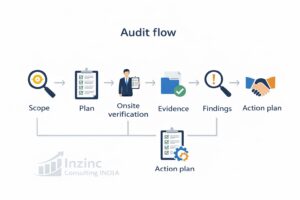
We start by defining audit objectives and scope. Then, we confirm sites, processes, and outsourced activities. Next, we align audit criteria with OEM requirements. Also, we agree the sampling approach and schedule.
Before the visit, we review key documents. Therefore, the onsite audit stays focused and efficient. We review policies, procedures, and process maps. Additionally, we review key records and performance metrics.
During the audit, we use interviews and walkthroughs. We also verify evidence through record sampling. Moreover, we follow process trails from input to output. So, we confirm implementation across real work conditions.
We hold a closing meeting with clear observations. Then, we summarize strengths and improvement areas. Additionally, we classify findings based on risk. Consequently, next steps become straightforward.
We share a structured audit report after completion. It includes evidence-based findings and practical recommendations. Also, it includes prioritization for faster closures. Therefore, leadership can act with confidence.
What the OEM Receives After the Audit?
 OEM teams need clarity, not lengthy narratives. Therefore, our reports are concise and decision-ready. They focus on risks, controls, and performance impact. Moreover, they separate facts from interpretation.
Typical outputs include these deliverables: audit scope, criteria, and audit coverage summary; process-level observations linked to objective evidence; conformities and good practices worth maintaining; nonconformities, if any, with clause mapping where relevant; opportunities for improvement, written with a practical tone; risk-based prioritization for action planning; supplier corrective action plan format for closure tracking; and an executive summary for procurement and quality leadership.
If required, we can support closure verification. Additionally, we can support supplier development roadmaps. So, the audit drives measurable improvement over time.
Making It Diplomatic and Supplier-Friendly
Supplier relationships need respect and professionalism. Therefore, we keep audits collaborative and well-planned. We avoid assumptions and avoid blame-based language. Instead, we focus on process evidence and outcomes.
We also respect confidentiality and intellectual property. Moreover, we request only necessary information. Additionally, we protect data access and security boundaries. So, suppliers feel safe and remain transparent.
We communicate findings using balanced wording. We highlight strengths before discussing gaps. Furthermore, we suggest realistic actions and timelines. Consequently, suppliers engage rather than resist.
When to Use Third Party Audits?
Use audits during supplier onboarding and approval. Also, use audits during annual supplier re-evaluation. Moreover, use audits after major business changes, such as new machines, new sites, or new processes.
Use audits after quality incidents or delivery failures. Additionally, use audits after security incidents or downtime. Then, use audits after regulatory changes. So, your governance stays aligned with real risk.
Use audits for high-risk or critical suppliers. Likewise, use audits for critical service providers. Therefore, assurance investments match business impact.
Industries and Use Cases We Commonly Support
We support manufacturing and services supply chains, including automotive, engineering, and precision manufacturing partners; aerospace and electronics supply networks; medical devices and regulated production ecosystems; food, packaging, and logistics operations; IT services, SaaS vendors, and managed support providers; and facilities, maintenance, and outsourced service operations.
Each industry has unique risk drivers. Therefore, we tailor audit depth and focus. Moreover, we adapt evidence trails to your realities. So, you get relevant supplier assurance outcomes.
Why Inzinc Consulting India Pvt. Ltd.?
We understand ISO requirements and operational reality. Therefore, our audits stay practical and implementable. We focus on evidence, not theory. Moreover, we respect the supplier’s business constraints.
We help OEMs see actual implementation maturity. We also help suppliers improve with clear actions. Additionally, we help procurement reduce supplier risk. So, your supply chain becomes stronger and more predictable.
Call to Action
If you want stronger supplier visibility, we can help. Share your supplier list and your priority categories. Then, we propose an audit program and schedule. Additionally, we align outputs with your governance needs.
With third party audits, assurance becomes objective. Moreover, improvement becomes structured and measurable. Therefore, OEMs gain confidence in supplier execution. And suppliers gain clarity for sustained performance.
Email us at ic@inzinc.in with the subject “Requirement of Third Party Audits” and we shall contact you.