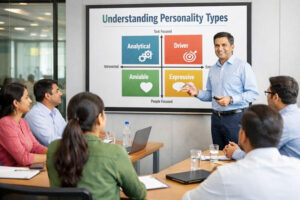
 Understanding Personality Types Training for Business and Teams by Inzinc Academy is an absolute must-have when Employees at all levels deal with varied personalities. Every workplace has talented people. However, talent alone does not guarantee smooth teamwork, strong leadership, sound hiring, better customer service, or consistent business decisions. In reality, people think differently, communicate differently, respond to pressure differently, and approach work in different ways. Therefore, organizations that understand personality differences can improve collaboration, reduce avoidable conflict, strengthen leadership, and make better use of individual strengths. That is exactly why training on understanding personality types has become highly relevant for modern businesses.
At Inzinc Academy (Training Division of Inzinc Consulting India Pvt. Ltd.), our Understanding Personality Types Training helps employees, managers, HR teams, business leaders, and customer-facing professionals understand how different personality types influence communication, decision-making, team dynamics, conflict resolution, hiring, performance reviews, diversity, creativity, innovation, customer service, sales, and marketing. Moreover, this training connects personality insights directly to business situations. As a result, participants do not just learn theory. Instead, they gain practical ways to work more effectively with different kinds of people.
Introduction to Understanding Personality Types Training
Personality refers to the unique and relatively consistent set of traits, behaviours, thoughts, and emotional patterns that characterize an individual’s psychological makeup. In the presentation, traits are described as qualities in a person, with examples such as extraversion, introversion, empathy, resilience, and emotional stability. Therefore, personality is not a superficial label. Rather, it shapes how a person thinks, interacts, decides, responds, and contributes in a workplace.
The training also explains that personality is influenced by heredity or genetics, family values and culture, upbringing, immediate circle of people, society, life events and experiences, peer influence, and cognitive ability. Consequently, personality must be understood with balance and maturity. It is neither a rigid box nor a complete explanation of performance. Instead, it is a useful lens for understanding behaviour patterns, communication preferences, work style, and interpersonal impact.
Who Must Take This Training?
Managers and Team Leaders
Managers work with people of different styles every day. Therefore, they need better insight into how team members communicate, make decisions, respond to feedback, and handle conflict.
HR and Talent Acquisition Teams
HR professionals, recruiters, and interviewers benefit from understanding personality patterns because it helps them evaluate people more carefully, avoid personality bias, and create fairer selection and development processes.
Sales, Customer Service, and Marketing Teams
These teams interact constantly with customers, prospects, and internal stakeholders. Hence, understanding different personality styles can improve persuasion, relationship-building, empathy, and service quality.
Employees Working in Teams
Any employee working in cross-functional teams can benefit from better self-awareness and stronger understanding of how colleagues approach communication, analysis, creativity, and collaboration.
Organizations Building Better Culture and Performance
This training is valuable for manufacturing companies, service companies, consulting firms, startups, educational institutions, IT companies, and growing businesses that want stronger people management and healthier collaboration.
Learning Objectives
By the end of this training, participants will be able to:
- Understand the meaning of personality and personality traits
- Recognize the major influences that shape personality
- Understand what personality types are and why they matter in business
- Gain familiarity with the Myers-Briggs Type Indicator or MBTI framework
- Understand the four MBTI dimensions and the 16 personality types
- Identify how personality types influence leadership and communication
- Recognize how personality differences affect decision-making and team building
- Understand the importance of avoiding personality type bias in the workplace
- Apply personality awareness in conflict resolution and collaboration
- Use personality insights more carefully in hiring and performance reviews
- Understand the connection between personality types and diversity, creativity, and innovation
- Apply personality awareness in customer service, sales, and marketing interactions
What This Training Covers?
Overview of Topics
- What personality is and how traits influence behaviour
- Major factors that influence personality formation
- Introduction to personality types in business settings
- Definitions of the MBTI dimensions
- The Myers-Briggs Type Indicator and its origins
- The 16 MBTI personality types
- Personality types and leadership styles
- Personality types and workplace communication
- Personality types and decision-making approaches
- Personality types and team building
- Importance of avoiding personality type bias
- Personality types and conflict resolution
- Personality types and hiring decisions
- Personality types and performance reviews
- Personality types and diversity and inclusivity
- Personality types and creativity
- Personality types and innovation
- Personality types and customer service
- Personality types and sales
- Personality types and marketing
What Are Personality Types?
The training explains that personality types are a useful way of understanding how people perceive and engage with their surroundings. It also notes that these types are shaped by a combination of genetic makeup, environmental factors, and cultural influences. Furthermore, the presentation introduces the Myers-Briggs Type Indicator as a widely used framework that categorizes individuals into one of sixteen distinct personality types.
This is helpful in business because people rarely fail only due to lack of technical skill. Very often, problems arise because communication styles clash, decisions are approached differently, conflict is mishandled, or strengths are misunderstood. Therefore, personality awareness can improve both human relationships and business performance.
Understanding the MBTI Framework
The presentation states that MBTI was developed from the works of Carl Jung and further developed by Katharine Cook Briggs and Isabel Briggs Myers. It also explains that the MBTI identifies 16 personality types based on four key dimensions:
- Extraversion versus Introversion
- Sensing versus Intuition
- Thinking versus Feeling
- Judging versus Perceiving
The training then explains each dimension in practical business language. For example, sensing focuses on concrete facts, details, and practical information, whereas intuition focuses on possibilities, patterns, and abstract ideas.
Likewise, extroversion relates to gaining energy from interaction, whereas introversion relates to gaining energy from reflection. Similarly, thinking emphasizes logic and objective analysis, whereas feeling emphasizes values, empathy, and impact on people. Finally, judging prefers structure and planning, whereas perceiving prefers flexibility and adaptability.
Why Personality Types Matter in Business
Leadership
The presentation explains that leadership styles can vary greatly depending on personality type. For instance, extroverted leaders may be more comfortable with public speaking and networking, while introverted leaders may excel in one-to-one communication and deep thinking. Likewise, thinking-oriented leaders may prioritize logic and data, whereas feeling-oriented leaders may prioritize empathy and compassion. Therefore, leadership effectiveness is often shaped by how well leaders understand both their own style and the needs of others.
Communication
The training highlights that effective communication is essential in business, yet different personality types communicate in different ways. For example, introverted individuals may prefer written communication, while extroverted individuals may thrive in group brainstorming. In addition, the presentation recommends using a variety of communication methods such as written communication, face-to-face meetings, phone calls, and video conferencing. It also emphasizes nonverbal cues such as tone of voice and body language. Consequently, personality-aware communication can improve business interactions and build stronger relationships.
Decision-Making
Different personality types approach decisions differently. Some prefer detailed information and structured evaluation, while others rely more on intuition and creative possibilities. The training gives examples such as a sensing-oriented HR manager using a structured hiring process and an intuitive creative director designing an unconventional marketing campaign. Therefore, understanding personality differences can improve the quality and balance of business decisions.
Team Building
The presentation explains that successful team building requires understanding the strengths and weaknesses of different personality types. It further suggests encouraging open communication, collaboration, trust, and opportunities for people to work on projects aligned with their strengths and interests. As a result, teams become more balanced, engaged, and productive.
Avoiding Personality Type Bias
A very important part of the training is the warning against personality type bias. The presentation states clearly that avoiding personality type bias is crucial because it ensures fairness and equal opportunity. When managers or colleagues make assumptions based only on personality type, they may limit someone’s potential and create unfair judgments. Therefore, this training helps organizations use personality insights responsibly, not carelessly.
This is especially relevant in hiring, appraisal, succession planning, and daily collaboration. Personality awareness should improve understanding. It should not create stereotypes.
Personality Types and Conflict Resolution
Conflict is a natural part of workplaces. However, the presentation explains that personality differences can intensify it. For example, a highly competitive person may clash with someone more collaborative and relationship-oriented. The training therefore recommends finding common ground, identifying shared goals, communicating clearly and respectfully, and being willing to compromise. In other words, personality awareness can transform conflict from a personal clash into a manageable difference in style.
Personality Types and Hiring
The training explains that understanding personality types can help hiring managers build more diverse and effective teams. However, it also stresses that managers must avoid bias toward particular personality styles. For example, introverts may be overlooked in favour of extroverts during interviews. Therefore, the presentation advises that hiring decisions should focus on skills and qualifications, while personality assessments should be used only as one part of a broader evaluation process that also considers experience, education, and references.
Personality Types and Performance Reviews
Performance reviews can also be influenced by personality differences. The training points out that a highly analytical employee may not naturally excel in areas requiring creativity and innovation. Therefore, managers should focus on objective criteria such as goals and deadlines, while also being aware of their own bias. This helps ensure fairer and more balanced evaluation.
Personality Types, Diversity, and Inclusion
The presentation connects personality understanding with workplace diversity and inclusivity. It explains that when teams recognize different strengths and communication styles, they can work together more effectively and build a more welcoming environment. It also gives an example of an extroverted team member contributing energy during brainstorming, while an introverted team member contributes precision and well-thought-out solutions. Therefore, understanding personality differences supports inclusion in a very practical way.
Personality Types and Creativity and Innovation
Creativity and innovation benefit from diverse approaches. The training explains that some people prefer to brainstorm alone, while others thrive in groups. It also recommends creating a safe space where all ideas can be heard, including unconventional ones. Moreover, the presentation states that successful innovation often requires collaboration between people with different strengths and perspectives. Therefore, teams that respect personality diversity are often better positioned to generate original ideas and stronger solutions.
Personality Types in Customer Service, Sales, and Marketing
The training extends personality awareness beyond internal teams. In customer service, it explains that some customers may prefer a direct and assertive approach, while others may respond better to a softer and more empathetic tone. Therefore, service quality improves when employees listen actively and adapt communication style to customer preference.
In sales, the presentation notes that extroverted personalities may excel at relationship-building, whereas analytical personalities may excel at explaining features and benefits. Likewise, in marketing, the training explains that campaigns can be strengthened by understanding the personality tendencies of the target audience. Consequently, personality awareness can improve not only internal collaboration, but also external business results.
Training Methodology
This program is designed as a practical, discussion-based business training session. It includes explanations, examples, business applications, and exercises linked to the MBTI dimensions and workplace scenarios. Because of that, participants can reflect on their own style, understand others more effectively, and apply the learning directly to leadership, communication, decision-making, conflict handling, hiring, customer interaction, and teamwork.
Why Choose Inzinc Consulting India Pvt. Ltd.?
At Inzinc Academy, we focus on business-relevant behavioural training that improves actual workplace effectiveness. Our Understanding Personality Types Training is not limited to labels or theory. Instead, it helps organizations use personality insights in a practical, balanced, and responsible way. As a result, teams communicate better, leaders manage more effectively, and businesses gain a stronger people advantage.
Contact Us
To discuss Understanding Personality Types Training for your organization, contact us at ic@inzinc.in