
ISO 9001 Certification for Logistics and Warehousing Organizations
Let us understand how ISO 9001 Certification for Logistics and Warehousing Organizations helps in the real sense. Logistics and warehousing businesses run on trust. A customer may not see the warehouse, the loading area, the documentation desk, the inward inspection process, the picking activity, or the dispatch verification step. However, the customer directly experiences the result. The shipment either reaches the right place or it does not. The quantity either matches the order or it does not. The material either remains safe or it gets damaged. The documents either support smooth delivery or they create delay, dispute and cost.
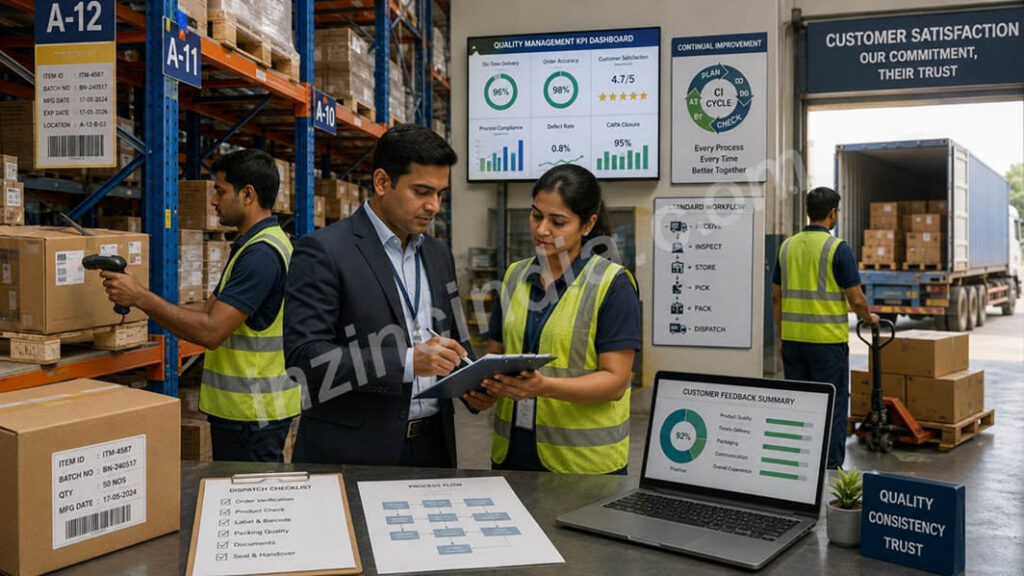
That is why ISO 9001 certification has strong practical value for logistics and warehousing organizations. It is not only a certificate to display on a website or submit with a tender. When implemented correctly, ISO 9001 helps logistics companies and warehouses build a controlled, measurable and improvement-focused Quality Management System.
For a logistics or warehousing organization in Bangalore, the business environment is especially demanding. The city serves manufacturing units, exporters, IT hardware suppliers, e-commerce sellers, engineering companies, pharmaceutical suppliers, food businesses, aerospace vendors, automotive component companies and many small and medium enterprises. These customers expect speed, accuracy, traceability and professional communication. Therefore, a weak internal system can quickly become a customer complaint.
ISO 9001 helps bring discipline into this operating environment.
Why ISO 9001 Matters for Logistics and Warehousing
Logistics and warehousing companies handle physical movement, storage, coordination, documentation and customer communication. Many failures happen because people depend on memory, informal communication and individual experience. Initially, this may work in a small business. However, as order volume increases, customers multiply, staff changes occur, and delivery expectations tighten, informal working methods start creating risk.
Common problems include wrong dispatch, delayed inward entry, stock mismatch, missing customer documents, unclear responsibility between warehouse and transport teams, unverified supplier performance, poor complaint analysis, and lack of evidence during customer escalations.
ISO 9001 addresses these issues by requiring the organization to define processes, determine responsibilities, control operations, maintain necessary records, monitor performance and improve weak areas. In simple terms, the standard asks the organization to run the business through a system rather than through assumptions.
For logistics and warehousing companies, this approach can improve:
Customer order handling
Inward material receipt
Storage and preservation
Inventory identification
Picking and packing
Dispatch verification
Transport coordination
Vendor and transporter control
Complaint handling
Delivery performance
Document control
Internal communication
Corrective action
Management review
The real benefit comes when the QMS reflects actual daily work. A copied manual or generic procedure will not help. The documentation must match how the warehouse receives, stores, protects, picks, packs and dispatches material.
The Real Purpose of ISO 9001 in a Warehouse Environment
Many organizations misunderstand ISO 9001. They think it is mainly about maintaining files for an audit. In reality, ISO 9001 is about controlling work so that customer requirements are consistently met.
In a warehouse, this means the organization should know what material has come in, where it is stored, who checked it, whether any damage was observed, what documents came with it, how it should be preserved, when it should be dispatched, and what evidence proves that dispatch happened correctly.
For example, if a customer asks why only 48 boxes reached the destination when the invoice says 50 boxes, the warehouse should not rely on verbal explanations. The organization should have evidence such as inward receipt, storage record, pick list, packing record, dispatch checklist, transporter handover document and delivery confirmation.
This is where ISO 9001 becomes useful. It does not tell every warehouse to use the same format. Instead, it expects the organization to determine suitable controls based on its own operations, risks and customer requirements.
ISO 9001 Certification and Customer Confidence
Many logistics and warehousing companies compete in a crowded market. Price matters, but price alone does not build long-term customer trust. Customers also look for reliability, professionalism, response speed, documentation accuracy and problem-solving ability.
ISO 9001 certification can support this trust. It tells customers that the organization has established a Quality Management System and has undergone an independent certification audit. However, the certificate alone does not create confidence. The customer gains confidence when the organization demonstrates discipline in daily operations.
A good logistics company should be able to answer practical questions clearly:
How do you identify customer material?
How do you prevent mix-up?
How do you control damaged goods?
How do you track dispatch accuracy?
How do you select and monitor transporters?
How do you handle customer complaints?
How do you train warehouse staff?
How do you review delayed deliveries?
How do you maintain records?
How do you prevent repeat mistakes?
When ISO 9001 is implemented with this mindset, it becomes a commercial advantage.
Key ISO 9001 Requirements Relevant to Logistics and Warehousing
ISO 9001 applies to all types of organizations, including service businesses. Logistics and warehousing organizations can apply the standard without difficulty because the standard focuses on process control, customer requirements, performance and improvement.
Context of the Organization
A logistics or warehousing company must understand internal and external issues that affect its Quality Management System. For example, traffic congestion, customer delivery deadlines, transporter availability, labour dependency, seasonal order peaks, warehouse space constraints, technology limitations and regulatory expectations can all influence service quality.
The organization should also understand interested parties. These may include customers, transporters, suppliers, employees, statutory authorities, landlords, insurance providers, certification bodies and top management.
This exercise should not become a formality. It should help management understand what can affect customer satisfaction and operational control.
Customer Requirements
Logistics and warehousing businesses must clearly understand customer requirements before accepting work. These requirements may include delivery timelines, packaging expectations, storage conditions, handling instructions, temperature requirements, insurance terms, documentation needs, reporting frequency, escalation points and service-level expectations.
If the organization accepts work without properly reviewing requirements, disputes may arise later. ISO 9001 expects the organization to review customer requirements before committing to delivery.
Operational Planning and Control
This is one of the most important areas for logistics and warehousing organizations. The company must plan and control the processes needed to deliver services.
In practical terms, this may include:
Defined inward material process
Material identification method
Storage location system
Handling and preservation controls
Picking and packing instructions
Dispatch verification process
Transporter handover method
Customer communication process
Damage reporting process
Service exception handling
Record retention rules
The organization should define the criteria for each process. For example, a dispatch checklist may require verification of customer name, invoice number, quantity, packing condition, transport document, vehicle number and handover signature.
Control of Externally Provided Services
Logistics and warehousing organizations often depend on transporters, labour contractors, packaging suppliers, maintenance providers, security agencies, pest control vendors, software providers and other external parties. If these external providers fail, the customer may still blame the logistics company.
Therefore, ISO 9001 expects control over externally provided processes, products and services. The organization should evaluate, select, monitor and re-evaluate important service providers.
For example, transporter performance can be monitored through on-time delivery, damage incidents, documentation errors, vehicle availability and responsiveness during escalations.
Identification and Traceability
Traceability is critical in warehousing. If material identification is weak, wrong dispatch and stock mismatch become common. ISO 9001 does not force one particular traceability method. The organization can use labels, barcodes, ERP, warehouse management software, bin cards, rack numbers, batch details or customer-specific identification methods.
The main expectation is simple: the organization should know what the item is, where it is, what its status is, and whether it is suitable for dispatch.
Preservation
Warehouses must preserve customer property and inventory. Preservation may include protection from moisture, dust, heat, contamination, physical damage, pest activity, wrong stacking, corrosion, expiry, mix-up and unauthorized access.
The preservation controls should match the type of goods handled. A warehouse storing engineering components will need different controls from a warehouse handling food products, electronics, pharma material or printed materials.
Control of Nonconforming Outputs
In logistics and warehousing, nonconformity may include damaged goods, wrong quantity, delayed delivery, wrong documentation, incorrect labelling, missing proof of delivery, wrong customer dispatch, shortage, excess dispatch, mixed material, or goods stored in the wrong location.
The organization should identify such issues, control them, inform relevant persons, decide the disposition, and maintain records. More importantly, it should analyse the cause and prevent recurrence where needed.
Common Problems ISO 9001 Can Solve in Logistics and Warehousing
A good ISO 9001 system can reduce many recurring operational problems. It will not magically solve everything, but it will create structure and accountability.
Wrong Dispatch
Wrong dispatch can damage customer confidence immediately. It usually occurs due to poor identification, unclear picking instructions, rushed loading, weak verification or poor communication between office and warehouse teams.
ISO 9001 can help by introducing controlled pick lists, dispatch verification, responsibility assignment, documented checks and corrective action for repeat errors.
Stock Mismatch
Stock mismatch creates financial loss and operational stress. It may arise because of delayed entries, unrecorded movement, wrong location storage, mixing of customer material, weak cycle counting or poor handover between shifts.
A practical QMS can introduce defined stock control methods, periodic verification, responsibility for entries, location discipline and review of mismatch trends.
Customer Complaint Repetition
Many organizations record complaints but do not analyse them properly. As a result, the same mistakes recur. ISO 9001 requires corrective action when needed. This means the organization should identify the root cause and take action that prevents recurrence.
For example, if repeated complaints occur due to wrong documentation, training alone may not solve the problem. The real corrective action may include a document checklist, system field validation, supervisory review, and clear responsibility before dispatch.
Poor Transporter Control
A warehouse may control its internal activities well, but delivery can still fail if transporter control is weak. ISO 9001 encourages supplier and service provider monitoring. Transporters can be evaluated based on performance, responsiveness, damage record, document handling and customer feedback.
Lack of Evidence During Disputes
When customers raise disputes, evidence matters. ISO 9001 helps organizations identify which records they must maintain. In logistics and warehousing, these may include inward records, inspection records, storage records, stock reports, dispatch checklists, transporter handover documents, customer approvals, complaint records and corrective action records.
ISO 9001 Certification Process for Logistics and Warehousing Companies
The certification journey should follow a structured path. A logistics or warehousing company should not start by preparing a generic manual. It should first understand the business processes and customer expectations.
Step 1: Understand Scope
The organization must define the scope of its Quality Management System. The scope may cover warehousing, storage, inventory handling, packing, dispatch coordination, logistics coordination, freight forwarding support, transporter coordination or related services.
The scope should reflect actual services. It should not overclaim activities that the organization does not perform.
Step 2: Map Processes
The next step involves process mapping. The organization should identify key processes such as sales enquiry, customer onboarding, inward receipt, storage, inventory control, picking, packing, dispatch, transporter coordination, customer communication, billing, complaint handling, HR, purchase, maintenance and management review.
Process mapping helps employees understand how work flows from customer requirement to service delivery.
Step 3: Identify Risks and Controls
Risks in logistics and warehousing may include wrong dispatch, delay, damage, loss, theft, wrong documentation, storage condition failure, software downtime, staff shortage, transporter non-performance and customer escalation.
The organization should identify practical controls. These may include checklists, approvals, system controls, training, verification steps, supplier monitoring, escalation rules and backup arrangements.
Step 4: Prepare Relevant Documentation
Documentation should support operations. It should not become an audit burden. A logistics or warehousing QMS may include a quality policy, quality objectives, process procedures, SOPs, work instructions, risk register, supplier evaluation records, training records, maintenance records, inward and dispatch formats, complaint register, corrective action records and internal audit records.
The best documentation uses the language of the business. Warehouse staff should understand it without difficulty.
Step 5: Train Employees
Training should cover ISO 9001 awareness, process responsibilities, customer requirements, document control, record maintenance, nonconformity reporting, safety-related handling requirements where applicable, and customer complaint handling.
Training should not remain limited to management. Warehouse supervisors, stores staff, dispatch coordinators, customer service executives and operations staff should understand their role in the QMS.
Step 6: Implement the System
Implementation means people use the defined processes in daily work. Records should show actual activity. Managers should review performance data. Supervisors should check whether controls work. Employees should raise issues instead of hiding them.
This stage separates serious implementation from paperwork.
Step 7: Conduct Internal Audit
The internal audit should verify whether the organization follows its own process and meets ISO 9001 requirements. In a warehouse, the auditor should physically verify storage, identification, preservation, dispatch control, damaged goods handling, records and customer complaint handling.
The audit should not become a checklist exercise alone. It should test whether the system can prevent customer-impacting failures.
Step 8: Conduct Management Review
Top management should review QMS performance. This includes customer feedback, complaints, process performance, supplier performance, audit results, risks, corrective actions, resource needs and improvement opportunities.
For logistics and warehousing companies, management review can highlight trends such as recurring delivery delays, frequent stock mismatch, transporter issues, manpower constraints and customer dissatisfaction.
Step 9: Certification Audit
After implementation, the organization can proceed with certification audit through an accredited certification body. The certification body generally conducts Stage 1 and Stage 2 audits. Stage 1 checks readiness, while Stage 2 verifies implementation effectiveness.
Organizations that need structured guidance for documentation, implementation, internal audit and certification readiness can explore practical support for ISO 9001 Certification in Bangalore from Inzinc Consulting India Pvt. Ltd.
What Records Should Logistics and Warehousing Companies Maintain?
Records should prove that the organization controlled its work. The exact records depend on the scope and process complexity. However, logistics and warehousing organizations commonly maintain customer requirement review records, inward material records, stock records, location records, damaged goods records, dispatch checklists, transporter handover records, proof of delivery, complaint records, corrective action records, supplier evaluation records, training records, equipment maintenance records, internal audit records and management review minutes.
A small warehouse can keep simple formats. A larger warehouse may use software. The method matters less than the reliability of the evidence.
Quality Objectives for Logistics and Warehousing
ISO 9001 expects measurable quality objectives. Logistics and warehousing companies should avoid vague objectives such as “improve quality” or “increase satisfaction” without measurable criteria.
Better objectives may include:
Improve on-time dispatch performance
Reduce wrong dispatch incidents
Reduce customer complaints related to documentation
Improve stock accuracy
Reduce damaged goods incidents
Improve transporter performance
Complete customer complaint response within defined time
Complete internal audits as planned
Train all warehouse staff on defined SOPs
Each objective should have a responsible person, target, measurement method and review frequency.
Practical Example of ISO 9001 in a Warehouse
Consider a Bangalore warehouse that handles engineering components for multiple customers. Before ISO 9001 implementation, the warehouse stores materials based on available space. Staff members remember customer locations. Dispatch happens quickly, but errors occur during month-end pressure. Sometimes, damaged packing gets noticed only during loading. Customer complaints increase.
After implementing ISO 9001 properly, the company defines customer-wise storage locations, rack identification, inward inspection checks, damage reporting rules, picking records, dispatch verification and transporter handover documentation. Supervisors review daily dispatch accuracy. Management reviews complaints every month. When wrong dispatch occurs, the team conducts root cause analysis and strengthens the verification step.
The warehouse has not become bureaucratic. Instead, it has become more predictable.
That is the real value of ISO 9001.
Mistakes to Avoid During ISO 9001 Implementation
Many logistics and warehousing companies fail to get full value from ISO 9001 because they treat it as a certificate project. They prepare documents quickly, train only a few people, rush the internal audit and wait for the certification body.
This approach may help obtain a certificate temporarily, but it will not improve operations.
Avoid these mistakes:
Using generic procedures that do not match warehouse activities
Ignoring actual floor-level practices
Creating too many formats that employees will not use
Not training dispatch and warehouse staff properly
Keeping quality objectives only for audit display
Failing to analyse customer complaints
Ignoring transporter performance
Not controlling damaged or unidentified goods properly
Treating internal audit as a formality
Not involving top management in performance review
A practical ISO 9001 system should make work clearer, not heavier.
Who Should Consider ISO 9001 Certification?
ISO 9001 certification can help many types of logistics and warehousing organizations, including third-party logistics providers, warehouse operators, transport coordination companies, distribution centres, freight forwarding support offices, inventory handling service providers, e-commerce fulfilment support units, industrial storage providers, packaging and dispatch support providers, and companies managing customer-owned material.
It is especially useful when the organization handles multiple customers, operates with defined delivery commitments, wants to participate in tenders, serves manufacturing or export customers, faces recurring complaints, wants better process discipline, or plans to scale operations.
Why Bangalore-Based Logistics and Warehousing Businesses Should Act Early
Bangalore continues to grow as a business and industrial hub. Logistics and warehousing companies support customers from Peenya, Electronic City, Bommasandra, Jigani, Whitefield, Hoskote, Nelamangala, Bidadi, Devanahalli and other industrial areas around Bengaluru. Customer expectations continue to rise because supply chains now demand faster response, better visibility and stronger documentation.
A company that implements ISO 9001 early can create a stronger operating foundation before growth creates pressure. It can train people better, define responsibilities clearly, reduce dependency on individual memory and show customers that it takes quality seriously.
Final Thoughts
ISO 9001 certification for logistics and warehousing organizations should not be viewed as a paperwork requirement. It should be treated as an opportunity to build a reliable operating system.
A warehouse may have space, racks, staff, vehicles and software. However, without process control, the business can still suffer from errors, delay, complaints and avoidable loss. ISO 9001 helps connect people, processes, documents, records, suppliers and customers into one controlled Quality Management System.
For logistics and warehousing companies, the most important question is not “Can we get ISO 9001 certification?” The better question is “Can we build a system that improves dispatch accuracy, customer confidence, traceability, complaint control and operational discipline?”
When the answer is yes, ISO 9001 becomes more than a certificate. It becomes a practical business improvement tool.