ISO 9001 Certification for Businesses in Bangalore
 Inzinc Consulting India Pvt. Ltd. supports organizations preparing for ISO 9001 Certification in Bangalore. We help businesses understand the certification process, define the correct certification scope, prepare for certification audits and select a suitable certification route.
ISO 9001:2026 specifies requirements for a Quality Management System, commonly called a QMS. It helps organizations control processes, meet customer requirements, monitor performance and improve continually.
However, ISO 9001 certification involves more than preparing documents. An organization must implement its QMS, maintain evidence, conduct internal audits, complete management review and close identified nonconformities before the certification audit.
Inzinc supports manufacturing companies, service providers, technology businesses, engineering units, logistics firms, healthcare organizations, educational institutions and other businesses across Bangalore and Karnataka.
Organizations that need detailed implementation, documentation and training support can also visit our ISO 9001 Consultants in Bangalore page.
What is ISO 9001?
ISO 9001 is an international standard that specifies requirements for a Quality Management System. It helps organizations manage interconnected processes, fulfil customer requirements, address risks, evaluate performance and pursue continual improvement.
The current published edition is ISO 9001:2026. The standard can apply to any organization, regardless of its size, sector, ownership or type of product or service.
ISO 9001 focuses on the management system rather than certifying an individual product. Therefore, certification demonstrates that the organization has established and implemented a QMS that meets the applicable requirements of the standard.
What Does ISO 9001 Certification Mean?

ISO 9001 certification means that an independent certification body has audited an organization’s Quality Management System against ISO 9001 requirements.
The certification body reviews whether the organization has defined its processes, implemented suitable controls, maintained required evidence and established methods for monitoring and improvement.
ISO develops and publishes international standards. However, ISO does not audit organizations or issue ISO 9001 certificates. Independent certification bodies conduct certification audits and issue certificates when organizations meet the applicable requirements.
Certification does not guarantee that every product will remain defect-free. Instead, it confirms that the organization follows a structured system for controlling quality, addressing problems and improving performance.
Benefits of ISO 9001 Certification

ISO 9001 certification can provide the following business benefits when the organization implements and maintains the QMS effectively:
- Greater customer confidence in the organization’s quality controls
- Better clarity of process responsibilities and performance expectations
- More consistent delivery of products and services
- Improved control of nonconforming outputs, complaints and corrective actions
- Stronger supplier evaluation and purchasing controls
- Better use of quality objectives and performance data
- Reduced dependence on undocumented individual practices
- Improved readiness for customer, regulatory and certification audits
- Better support for tenders, vendor registration and customer approval
- Stronger organizational discipline and continual improvement
- Improved ability to identify process risks and improvement opportunities
- Better management visibility of performance, problems and required actions
Certification creates the greatest value when management treats the QMS as a business system. In contrast, a QMS maintained only before audits may produce paperwork without sustained improvement.
Read also our blog on How ISO 9001 Certification Can Improve Customer Satisfaction?
Who Can Obtain ISO 9001 Certification?

Any organization can pursue ISO 9001 certification, regardless of size or industry. The standard applies to private businesses, public organizations, nonprofit institutions and other entities that need a structured Quality Management System.
Organizations commonly seeking ISO 9001 Certification in Bangalore include:
- Engineering and manufacturing companies
- Aerospace and automotive suppliers
- Electrical and electronics businesses
- Precision machining and fabrication units
- Information technology and software companies
- SaaS, BPO and professional service providers
- Logistics, transport and warehousing companies
- Construction and facility management firms
- Hospitals and healthcare service providers
- Educational and training institutions
- Trading, distribution and retail businesses
- Start-ups and small businesses
- Consulting and research organizations
The organization does not need a minimum number of employees. Nevertheless, the QMS scope and documentation should reflect its size, process complexity and business risks.
ISO 9001 Certificate validity period
How long is an ISO 9001 Certificate valid?
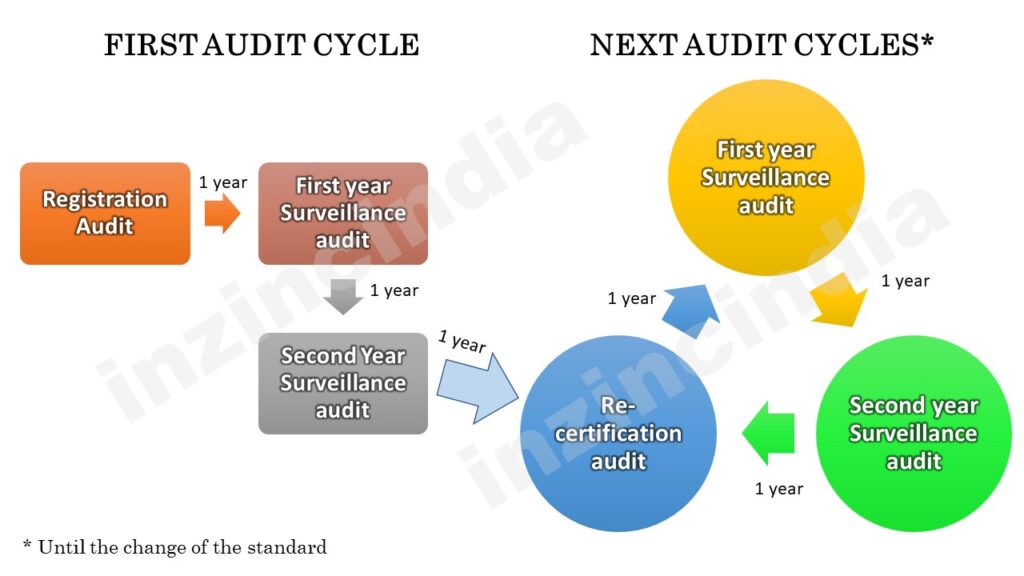
An ISO 9001 certificate normally operates within a three-year certification cycle, subject to successful surveillance activities and continued conformity.
After the initial certification audit, the certification body usually conducts surveillance audits during the first and second years. Before the end of the cycle, it conducts a recertification audit to evaluate continued conformity and renew certification.
The exact audit programme depends on the certification body, accreditation requirements, organization size, scope and audit findings.
Organizations should track certificate expiry dates and schedule recertification early. Furthermore, they should verify that their certificate details appear correctly in the certification body’s verification system or other applicable certification database.
Note on ISO 9001 Certification expiry: If an Organization does not renew the ISO Certificate before Re-certification audit, the ISO 9001 Certification will be expired and the Certification body should be contacted immediately. Certification bodies provide means of ISO 9001 Certification verification online for validation check to ensure the Certificate is not a fake one.
How to Define the ISO 9001 Certification Scope?
The ISO 9001 certification scope describes the activities, products, services and locations covered by certification. A clear scope helps customers understand what the certificate represents.
The scope should consider:
- Products and services included in the QMS
- Physical and operational locations covered
- Relevant business processes
- Design and development responsibilities, where applicable
- Activities performed internally or through external providers
- Applicable statutory, regulatory and customer requirements
A scope such as “Industrial training services” may be too broad. A more informative scope could state “Design and delivery of technical training programmes for the aerospace and engineering sectors.”
The organization should ensure that the certification scope accurately reflects its actual activities. Moreover, it should inform the certification body when major changes affect certified locations, products, services or processes.
How long does it take to get ISO 9001 certified?
The time required for ISO 9001 certification depends on the organization’s size, number of locations, process complexity, existing controls, employee availability and implementation readiness.
A small organization with documented and controlled processes may prepare faster. However, a complex or multisite organization may need more time for process alignment, implementation evidence, internal audits and corrective-action closure.
The preparation period may range from several weeks to several months. Therefore, organizations should avoid selecting an artificial certification date before assessing their readiness.
The certification body’s audit availability also affects the final schedule.
ISO 9001 Certification Process in Bangalore
Steps to Obtain ISO 9001 Certification
The ISO 9001 Certification Process steps in Bangalore are as per the flowchart shown below:
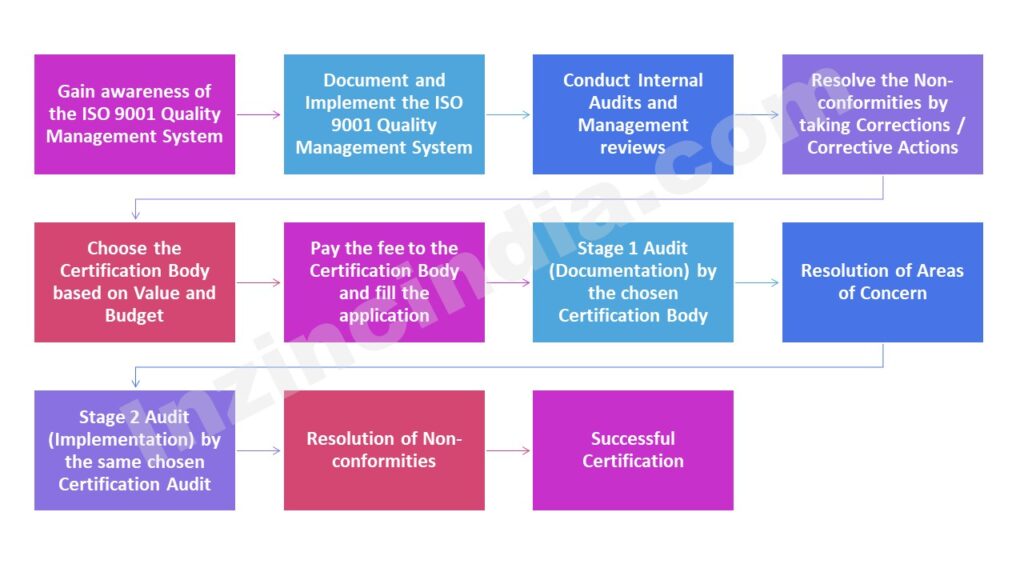
1. Define the Certification Objective and Scope
Identify why the organization needs certification. Customer requirements, tender eligibility, vendor approval, process improvement or market expectations may influence the objective.
Next, define the activities, locations, products and services that the certification will cover.
2. Understand ISO 9001 Requirements
Management and relevant employees should understand the QMS requirements that affect their roles. This creates better ownership and reduces dependence on last-minute audit preparation.
3. Assess Current Readiness
Compare existing processes, documents and records against ISO 9001 requirements. The assessment should identify available controls, missing requirements and implementation weaknesses.
4. Establish and Implement the QMS
Define processes, responsibilities, risks, objectives, controls and required documented information. Then operate the system and maintain evidence.
For detailed implementation support, visit our ISO 9001 Consultants in Bangalore page.
5. Conduct the Internal Audit
The organization must audit its QMS before certification. The internal audit should evaluate conformity, implementation and effectiveness.
6. Complete the Management Review
Top management should review QMS performance, customer feedback, objectives, audit results, resources, risks, corrective actions and improvement opportunities.
7. Close Internal Findings
Resolve identified nonconformities and maintain evidence of correction, root-cause analysis and corrective action where required.
8. Select a Certification Body
Evaluate certification bodies based on accreditation, industry experience, customer acceptance, audit competence, service quality, geographic coverage and total certification-cycle cost.
Do not select a certification body only because it offers the lowest quotation.
9. Submit the Application
Provide accurate information about employee strength, locations, activities, shifts, outsourced processes and proposed certification scope. The certification body uses this information to determine audit time and prepare its quotation.
10. Complete the Stage 1 Audit
The certification body reviews management-system documentation, scope, site conditions and readiness for Stage 2.
The organization must address any Stage 1 concerns before the next audit stage.
11. Complete the Stage 2 Audit
The Stage 2 audit evaluates QMS implementation and effectiveness. Auditors review processes, records, employee awareness, performance monitoring, internal audits, management review and corrective actions.
12. Close Certification-Audit Nonconformities
The organization must respond to audit nonconformities within the certification body’s specified timeframe. The response may require correction, root-cause analysis, corrective action and implementation evidence.
13. Receive and Verify the Certificate
After successful closure and certification decision, the certification body issues the ISO 9001 certificate.
Check the organization name, certified locations, scope, standard, certificate number, issue date and expiry date carefully.
14. Maintain Certification
Continue internal audits, management reviews, objective monitoring, corrective actions and QMS improvement. In addition, prepare for scheduled surveillance and recertification audits.
Need help implementing the QMS before certification? Learn how our ISO 9001 Consultants in Bangalore support gap assessment, documentation, implementation, training and internal audits.
For Small Businesses, check-out our blog titled “Top 10 Benefits of ISO 9001 Certification for Small Businesses“
ISO 9001 Certification Cost in Bangalore
What is the cost of ISO 9001 certification?

There is no single fixed ISO 9001 certification cost for every organization. The total cost depends on several factors:
- Number of employees
- Number of operating locations
- Certification scope
- Process complexity
- Number of shifts
- Industry risk
- Existing QMS readiness
- Certification body selected
- Required audit duration
- Travel and related audit expenses
- Consultancy or implementation support required
Consultancy fees and certification-body fees are normally separate.
Consultancy fees may cover gap assessment, documentation, implementation guidance, training, internal audit and certification-readiness support.
Certification-body fees generally cover application review, Stage 1 audit, Stage 2 audit, certificate administration, surveillance audits and recertification.
A low quotation does not automatically represent good value. Therefore, confirm whether customers, tender authorities and international buyers will accept the proposed certificate.
For a practical estimate, share your employee strength, locations, business activities, certification scope and current QMS status with Inzinc.
How to Choose an ISO 9001 Certification Body
Choose the certification body carefully because it conducts the independent audit and issues the certificate.
Consider the following points:
- Whether the certification body holds suitable accreditation
- Whether customers or tender authorities accept its certificates
- Whether it has competent auditors for your industry
- Whether it provides transparent certification-cycle costs
- Whether it clearly explains surveillance and recertification requirements
- Whether its certificate-verification system works reliably
- Whether it follows proper impartiality requirements
- Whether it avoids promising guaranteed certification without an audit
Ask your important customers whether they require certification from a particular accreditation system before finalizing the certification body.
Inzinc may assist with certification-body coordination. However, the certification body makes the independent certification decision.
Documents and Evidence Required for the Certification Audit
ISO 9001 does not prescribe the same document list for every organization. The required documented information depends on business activities, process complexity and QMS needs.
However, certification auditors commonly review:
- QMS scope
- Quality policy
- Quality objectives
- Process responsibilities and interactions
- Risks and opportunities
- Competence and training evidence
- Customer-requirement review records
- Supplier evaluation and purchase controls
- Production or service-delivery records
- Inspection and monitoring records
- Calibration or equipment-control records, where relevant
- Nonconforming-output records
- Customer complaints and feedback
- Corrective-action records
- Internal audit programme and reports
- Management review records
- Performance-monitoring evidence
Auditors evaluate both documents and actual implementation. Therefore, newly created formats without genuine operating records will not demonstrate an effective QMS.
How Inzinc Supports ISO 9001 Certification Readiness?
Inzinc helps organizations prepare systematically for ISO 9001 certification. Our support can include readiness assessment, QMS implementation planning, internal audit, management review guidance, corrective-action support and certification-body coordination.
Because this page focuses on certification, detailed information about documentation, training and implementation appears on our dedicated ISO 9001 Consultants in Bangalore page.
Our certification-readiness approach focuses on:
- Defining an accurate certification scope
- Checking readiness before the certification audit
- Identifying missing evidence and weak controls
- Conducting or supporting internal audits
- Guiding management review preparation
- Supporting closure of internal findings
- Coordinating certification audit requirements
- Helping teams understand Stage 1 and Stage 2 expectations
- Supporting corrective responses after the audit
Inzinc does not issue ISO 9001 certificates. An independent certification body conducts the audit and makes the certification decision.
Areas We Support in Bangalore and Karnataka
Inzinc supports businesses across Bangalore, including Peenya, Yeshwanthpur, Rajajinagar, Jigani, Bommasandra, Electronic City, Whitefield, Koramangala, Hebbal, Hoskote, Jayanagar and surrounding industrial and business areas.
We also support organizations across Karnataka through onsite, remote or hybrid engagement, depending on project requirements.
For ISO 9001 Certification in Bangalore, call +91 93799 17239 or email ic@inzinc.in.
Frequently Asked Questions
Is ISO 9001 certification mandatory?
ISO 9001 certification is not mandatory for every organization. However, customers, tenders, vendor-registration programmes or contractual requirements may make it commercially necessary.
Does ISO issue ISO 9001 certificates?
No. ISO publishes the standard. Independent certification bodies audit organizations and issue certificates after completing their certification process.
Can a small business obtain ISO 9001 certification?
Yes. ISO 9001 applies to organizations of any size. A small business can use a simpler QMS that suits its operations, risks and employee competence.
How long does ISO 9001 certification take?
The period depends on size, process complexity, existing controls, implementation readiness and certification-body availability. Preparation may take several weeks or several months.
What happens during the Stage 1 audit?
The certification body reviews the QMS scope, documented information, location conditions and readiness for Stage 2. It may identify concerns that the organization must address.
What happens during the Stage 2 audit?
Auditors evaluate actual implementation. They review processes, employees, records, performance monitoring, internal audits, management review and corrective actions.
How long is an ISO 9001 certificate valid?
An ISO 9001 certificate usually operates within a three-year certification cycle, subject to successful surveillance audits and continued conformity.
Are consultancy and certification fees separate?
Yes, they are generally separate. The consultant supports preparation and implementation. The independent certification body conducts the certification audit and issues the certificate.
Can Inzinc issue an ISO 9001 certificate?
No. Inzinc provides consulting and certification-readiness support. An independent certification body conducts the audit and makes the certification decision.
How can I verify an ISO 9001 certificate?
Check the certificate number, organization name, locations, scope, standard, issue date and expiry date through the certification body’s verification system or other applicable certification database.
Does the lowest ISO 9001 quotation provide the best value?
Not necessarily. Consider accreditation, customer acceptance, audit competence, certificate credibility and total three-year cost before selecting a certification body.
Can Inzinc support surveillance or recertification audits?
Yes. Inzinc can support internal audits, QMS updates, management reviews, corrective actions and readiness before surveillance or recertification audits.
Reviewed by Sudhir GK, Lead Consultant, Inzinc Consulting India Pvt. Ltd.
Last reviewed: 25-Jun-2026
Start Your ISO 9001 Certification Journey
Planning ISO 9001 Certification in Bangalore requires a clear scope, an implemented QMS, sufficient operating evidence and proper audit preparation.
Inzinc can help you understand the certification process, assess readiness and prepare confidently for Stage 1 and Stage 2 audits.