ISO 14001 Consultants in Bangalore – Karnataka
 Our Inzinc Consulting India Pvt. Ltd. team comprises of experienced ISO 14001 Consultants in Bangalore, Karnataka ensure the planning, documentation, implementation, maintenance and continual improvement of Environmental Management System as per the clauses laid out by the ISO 14001:2026 Standard.
We handhold our Customers, guide them, make them thoroughly understand the advantages of the ISO 14001 system. In this manner, our Client organizations can put a solid foundation upon which they can continually improve their environmental performance.
What is ISO 14001 Standard ?

ISO stands for International Organization for Standardization, which has its headquarters in Geneva, Switzerland. ISO is an independent, non-governmental international organization that publishes International Standards covering various technical and management disciplines. One such standard is ISO 14001 — Environmental management systems — Requirements with guidance for use.
The current edition is ISO 14001:2026, published in April 2026. It replaces ISO 14001:2015 and provides requirements that organizations can use to establish, implement, maintain and continually improve an Environmental Management System.
ISO 14001:2026 retains the well-established Environmental Management System framework of the 2015 edition while clarifying and strengthening requirements in areas such as environmental conditions, climate change, biodiversity, life-cycle considerations, risks and opportunities and management of change.
Why implement the ISO 14001 Standard ?
 Recent decades have seen increasing environmental problems due to human activities both at personal and professional levels. The results are adverse effects on environment and climate change which will have serious environmental impact on the future generations. Our generation needs to be more responsible and we need to implement a system that improves our Environmental performance. This can be accomplished by implementing the ISO 14001 Environmental Management System standard.
Who can implement ISO 14001 Standard ?

The ISO 14001 standard is generic in nature. Therefore, any organization, regardless of its size, type or nature and whether it provides products, services or both, can implement an Environmental Management System based on ISO 14001:2026.
The same ISO 14001 requirements apply across different sectors, although the manner and extent of implementation will naturally differ depending upon the organization’s context, environmental aspects, compliance obligations, activities, products, services and environmental risks and opportunities.
For an organization claiming conformity to ISO 14001:2026, the requirements of the standard cannot simply be excluded. All requirements applicable within the defined Environmental Management System scope are required to be incorporated and fulfilled.
Our experienced ISO 14001 Consultants in Bangalore, Karnataka help organizations interpret the requirements in relation to their actual operations rather than unnecessarily creating documentation or controls that are not relevant to the organization.
What are the ISO 14001 clauses ?
 There are ten ISO 14001 Clauses in the latest ISO 14001:2026 Standard. So, a Clause is nothing but a rule or a requirement that needs to be followed to achieve a result. The following is the orderly list of the ISO 14001 Clauses as per the 2026 version:
- Scope
- Normative References
- Terms and Definitions
- Context of the Organization
- Leadership
- Planning
- Support
- Operation
- Performance Evaluation
- Improvement
The overall Clause 1 to Clause 10 structure remains familiar to organizations already using ISO 14001:2015. However, some subclauses have been reorganized or clarified in the 2026 edition.
(Courtesy: ISO)
What are the benefits of implementing ISO 14001 ?
 By implementing the ISO 14001 Environmental Management System (EMS), Organizations can realize various business benefits. Below is a list of key ISO 14001 benefits:
- Improve environmental performance of the Organization
- Reduce environmental pollution related to air, water, land, flora, and fauna
- Minimize environmental risks
- Manage Environmental aspects and impacts of the Organization
- Builds confidence among stakeholders including Customers and public regarding seriousness of the Organization towards Environment
- Better compliance to Environmental laws and regulations can be accomplished since the ISO 14001 standard emphasizes on meeting Compliance obligations / legal requirements
- Monitoring and measurement of processes along with audits act as a check for analyzing performance and correcting the short falls.
- Organization can now be an active part of global, national or regional environmental initiatives
- Resources can be utilized in an optimum way and costs can be saved
Plan – Do – Check – Act (PDCA) Cycle
ISO standards advocate the use of an improvement cycle called as the Plan-Do-Check-Act cycle or PDCA Cycle.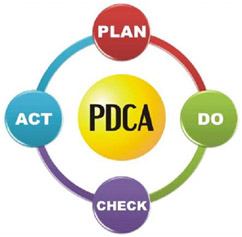
This was first advocated by the renowned Quality Guru Dr. Edwards Deming and hence it is also called “Deming Cycle”.
The PDCA cycle concept can be applied to any process or to the entire system or even to the ISO 14001 Clauses. It helps to realize continual improvements (step by step improvements) and churn out the waste from the system.
Our ISO 14001 Consultants in Bangalore, Karnataka demonstrate how to use the PDCA for business improvements.
Key features of ISO 14001 Standard
The ISO 14001:2026 Standard has the following key features as requirements:
- Harmonized Management System Structure: ISO 14001:2026 follows ISO’s harmonized structure for management system standards. This facilitates integration with standards such as ISO 9001 and ISO 45001 where organizations operate an Integrated Management System.

- Context of the Organization: Organizations are required to understand the internal and external issues relevant to their purpose and Environmental Management System. ISO 14001:2026 makes the environmental dimension clearer by specifically referring to environmental conditions such as pollution levels, availability of natural resources, climate change, biodiversity and ecosystem health.
- Interested Parties and Compliance Obligations: Relevant interested parties and their relevant needs and expectations are required to be determined. The organization must also determine which requirements become compliance obligations and address those obligations through its Environmental Management System.
- Risks and Opportunities: ISO 14001:2026 provides a clearer structure for determining environmental risks and opportunities. Clause 6.1.4 specifically addresses risks and opportunities associated with environmental aspects, compliance obligations, context issues and relevant interested-party requirements.
- Leadership and Accountability: Top Management continues to have direct accountability for the effectiveness of the Environmental Management System and for integrating environmental management requirements into the organization’s business processes. ISO 14001:2026 does not require appointment of a specific Management Representative. Responsibilities and authorities for relevant Environmental Management System roles are required to be assigned and communicated.
- Documented Information: ISO 14001:2026 continues the flexible approach to documented information. The extent of documentation can differ depending on factors such as the organization’s size, activities, processes, compliance obligations, process complexity and competence of personnel.
- Environmental life cycle perspective: Organizations are required to consider a life-cycle perspective when determining environmental aspects. ISO 14001:2026 further clarifies the organization’s authority and ability to exercise control and influence over the life cycle of its activities, products and services. A full formal Life Cycle Assessment is not automatically required. The organization needs to consider the relevant life-cycle stages over which it has control or influence.
- Planning of Changes: ISO 14001:2026 now contains a specific Clause 6.3 on Planning of Changes. Changes affecting or capable of affecting the Environmental Management System must be carried out in a planned manner so that the intended outcomes of the EMS can continue to be achieved.
- Environmental Objectives: Environmental objectives are required to be established at relevant functions and levels, taking significant environmental aspects and related compliance obligations into account and considering risks and opportunities. Objectives are to be measurable where practicable, monitored, communicated, updated as appropriate and maintained as documented information.
Our ISO 14001 Consultants in Bangalore, Karnataka explain these requirements practically and help organizations integrate them into existing business processes rather than treating ISO 14001 as a separate documentation exercise.
What has changed from ISO 14001:2015 to ISO 14001:2026?
ISO 14001:2026 is an evolution of ISO 14001:2015 rather than a complete redesign of the Environmental Management System standard. Organizations having a mature ISO 14001:2015 system will find that much of their existing EMS can continue to be used. The principal requirement is to review the system against the revised and clarified requirements.
The important changes include:
1. Environmental conditions are more explicit – Clause 4.1
ISO 14001:2026 specifically refers to environmental conditions such as pollution levels, availability of natural resources, climate change, biodiversity and ecosystem health.
What this means: Organizations should ensure that their context analysis considers environmental conditions that can affect the organization as well as conditions that the organization can affect. A generic SWOT analysis that overlooks relevant environmental conditions may no longer be sufficient.
2. Interested-party requirements have a clearer link to the EMS – Clause 4.2
Relevant needs and expectations that become compliance obligations are required to be addressed through the Environmental Management System.
ISO 14001:2026 also highlights that interested parties can have expectations connected with pollution, natural resources, climate change, biodiversity and ecosystem health.
What this means: Organizations should review their interested-party analysis and ensure accepted environmental requirements flow into appropriate operational controls, compliance evaluation, monitoring, objectives or other EMS processes.
3. Life-cycle perspective is strengthened in determining the EMS scope – Clause 4.3
The 2026 edition expressly refers to the organization’s authority and ability to exercise control and influence over the life cycle of its activities, products and services.
What this means: Organizations should consider relevant upstream and downstream stages such as procurement, external providers, transportation, product or service use and end-of-life activities wherever they can exercise control or influence.
4. Environmental aspects are clarified – Clause 6.1.2
Environmental aspect determination now clearly addresses normal and abnormal operating conditions, changes and potential emergency situations. The life-cycle stages are also made clearer.
What this means: Aspect-Impact Registers should adequately consider normal operation, abnormal conditions, foreseeable environmental emergencies, planned changes and relevant life-cycle stages.
5. Risks and opportunities now have a separate clause – Clause 6.1.4
In ISO 14001:2015, risks and opportunities were largely addressed within Clause 6.1.1. ISO 14001:2026 provides a separate Clause 6.1.4 for Risks and Opportunities.
What this means: Organizations should be able to demonstrate a clear relationship between their risks and opportunities and environmental aspects, compliance obligations, context issues and relevant interested-party requirements.
6. Planning action is now Clause 6.1.5
Planning action was Clause 6.1.4 in ISO 14001:2015. It becomes Clause 6.1.5 in ISO 14001:2026 following the introduction of the separate Risks and Opportunities clause.
What this means: EMS manuals, procedures, internal audit checklists, training materials and other documents containing clause references should be reviewed and updated where necessary.
7. New explicit requirement for Planning of Changes – Clause 6.3
ISO 14001:2026 introduces a dedicated Clause 6.3 requiring changes that affect or can affect the Environmental Management System to be carried out in a planned manner.
Examples can include changes to processes, products, services, equipment, facilities, materials, legal requirements, contractors, suppliers, personnel or environmental knowledge.
What this means: Organizations should have an effective way of evaluating environmental consequences before implementing relevant changes. This does not necessarily require a complicated standalone procedure; the requirement can be integrated into an organization’s existing change-management process.
8. Environmental indicators are clarified
The definition of an indicator is broadened so that an indicator may be quantitative, qualitative or binary.
What this means: Environmental performance need not always be represented only by numerical indicators. Appropriate qualitative or Yes/No indicators can also be used where they provide meaningful information.
9. Management review structure is clearer – Clause 9.3
ISO 14001:2026 organizes Management Review into:
- 9.3.1 General
- 9.3.2 Management review inputs
- 9.3.3 Management review results
What this means: The basic management review concept remains familiar, but organizations should update clause references and ensure all specified inputs and results are addressed.
10. Clause 10 has been reorganized
ISO 14001:2015 contained:
- 10.1 General
- 10.2 Nonconformity and corrective action
- 10.3 Continual improvement
ISO 14001:2026 contains:
- 10.1 Continual improvement
- 10.2 Nonconformity and corrective action
Continual improvement is therefore brought directly into Clause 10.1.
What this means: This is principally a restructuring and clarification, but EMS documents and audit checklists containing old Clause 10 references should be updated.
If you want more details, please refer to our article on ISO 14001 2026 changes
What should organizations certified to ISO 14001:2015 do?
Organizations should not discard or completely rebuild an effective ISO 14001:2015 Environmental Management System.
A practical transition should include:
- reviewing the EMS against ISO 14001:2026;
- updating the context and interested-party analysis;
- reviewing environmental aspects using the clarified life-cycle, normal, abnormal and emergency considerations;
- reviewing risks and opportunities against Clause 6.1.4;
- introducing or strengthening planning and control of changes under Clause 6.3;
- updating affected clause references in EMS documents and internal audit checklists;
- training relevant personnel and internal auditors on the revised requirements;
- conducting an internal audit against ISO 14001:2026; and
- reviewing transition readiness during Management Review.
The extent of change will depend on the maturity of the existing Environmental Management System. An organization that has implemented ISO 14001:2015 effectively may need only focused changes rather than wholesale redevelopment of its EMS.
ISO 14001 Family of Standards
 ISO 14001 standard is assisted by the following key support standards which can be referred to for additional knowledge:
- ISO 14004, Environmental management systems — General guidelines on principles, systems and support techniques
- ISO 14005, Environmental management systems — Guidelines for a flexible approach to phased implementation
- ISO 14006, Environmental management systems — Guidelines for incorporating ecodesign
- ISO 14031, Environmental management — Environmental performance evaluation — Guidelines
- ISO 14044, Environmental management — Life cycle assessment — Requirements and guidelines
- ISO 14063, Environmental management — Environmental communication — Guidelines and examples
For more details on the ISO 14001:2026 standard, visit the official ISO.org website.
Our scope of ISO 14001 Consulting
 Our scope of ISO 14001 Consulting covers the documentation, training, implementation guidance, conducting audits or help conduct audits and guidance on conducting Management Review Meetings (by our Client’s Top Management). Our ISO 14001 Consultants in Bangalore, Karnataka provide guidance in resolving the Non-conformities and take the required Corrections and Corrective actions.
How Long Does It Take to Implement ISO 14001?

The time required to implement ISO 14001 depends on several factors, including the size of the organization, the complexity of its processes, and the existing environmental management practices. Generally:
- Small Organizations: Implementation can take 2 to 4 months if resources are readily available and processes are straightforward.
- Medium-Sized Organizations: Typically, it takes 4 to 6 months, depending on the number of processes and operations involved.
- Large Organizations: For complex operations or multiple locations, implementation may take 6 to 12 months or more.
Factors that can influence the timeline include:
- Availability of resources and staff commitment.
- Existing documentation and processes related to environmental management.
- The organization’s ability to identify and address environmental aspects and impacts.
- Training and awareness programs for employees.
Our team of ISO 14001 Consultants in Bangalore ensures a streamlined and efficient implementation process by guiding your organization step-by-step, minimizing delays, and helping achieve certification as quickly as possible.
Other ISO 14001 Consulting Services
 Apart from the ISO 14001 Consulting assignment, we take up specific assignments such as the Environmental Aspect-Impact study / analysis.
This service includes:
- Defining and understanding the terms such as Environmental aspects, impacts, significant aspects and significant impacts
- Guidance on identification of environmental aspects related to the activities, products and services of our Client Organization
- For each identified aspect, determination of environmental impacts
- Determining the significant environmental aspects among the identified environmental aspects based on a significance criteria
- Guidance on operational controls to be implemented for each identified significant aspect
- Presenting the Aspects and Impacts in the form of an ISO 14001 aspects and impacts register or Aspect-Impact Chart
If you need ISO 14001 Aspect Impact study in Bangalore, Mumbai, Delhi, Chennai, and other parts of India, please write to ic@inzinc.in
Contact the Best ISO 14001 Consultants in Bangalore Now!
Call 9379917239 for more information
Other services in our Inzinc Consulting India Home page